
Pricing ▪ Discount ▪ Retention ▪ Expansion
What you walk away with
Named artifacts. Each is a concrete, version-controlled deliverable — not a capability promise — that survives the engagement.
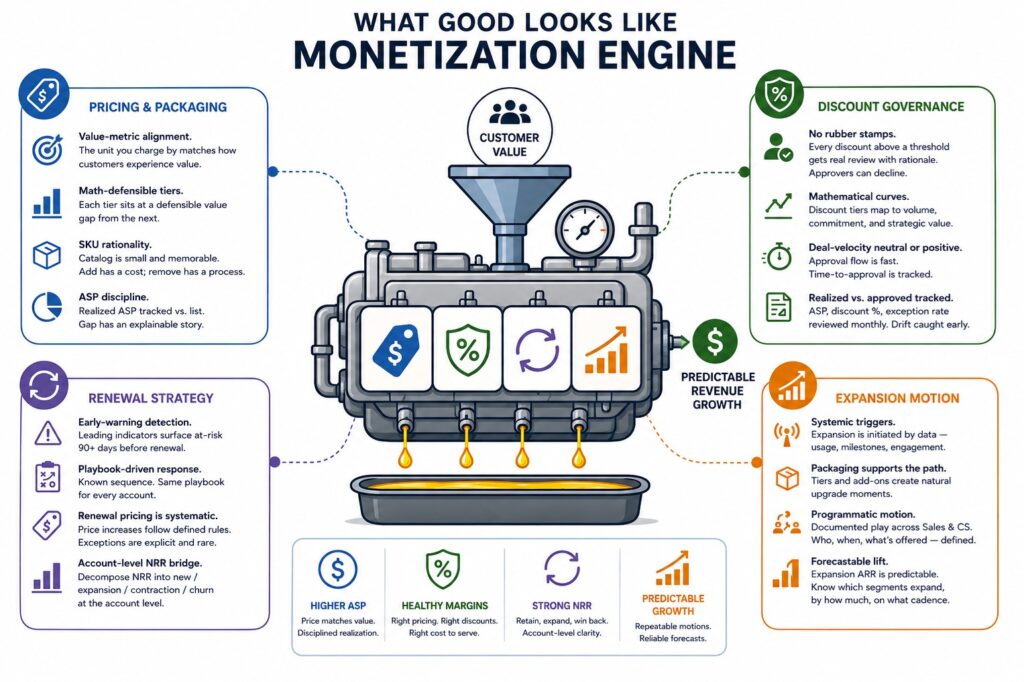
Pricing & Packaging
- Pricing & Packaging Playbook. The complete restructuring: tier design, value-metric definition, list-price discipline, and the SKU Rationalization Matrix (current catalog scored against value, sales complexity, and strategic intent — with explicit “keep / merge / kill” recommendations).
- Value-Metric Brief. The single-page rationale for what you charge by and why — defensible to buyers, sales, and product. Anchors every pricing decision downstream.
- List-to-Realized Model. The model that ties list price to expected realized ASP given your discount distribution. Turns list-price changes into measurable ASP shifts.
Discount Governance
- Discount Approval Matrix. Mathematical discount curves tied to deal size, commitment, and strategic value, with explicit approval thresholds (Rep → Manager → VP → CFO).
- Deal-Desk Playbook. The operating cadence — who reviews what, when, with what data — plus the Exception Protocol that documents how exception requests get evaluated, decided, and logged for pattern detection.
- Pricing Waterfall Tracker. The monthly view: list → invoice → realized. Where ASP leaks, by segment, with explainable drivers.
Renewal Strategy
- Account-Level NRR Bridge. A diagnostic waterfall isolating expansion / cross-sell / contraction / churn down to the individual account. Leaking cohorts become visible.
- At-Risk Remediation Playbook. Trigger-based action plan: what CS and Sales execute when an account exhibits specific churn signals. Includes the Early-Warning Indicator Set — the 5–8 leading signals (usage decay, support spike, CSM disengagement, stakeholder change) with thresholds that fire the playbook 90+ days out.
- Renewal Pricing Framework. Defined rules for price increases at renewal — by tier, tenure, and usage. Exceptions are explicit and tracked.
Expansion Motion
- Expansion Playbook. Documented upsell and cross-sell motion: triggers, ownership (CS vs. Sales), conversation framing, packaging offered, success metrics. Includes the Expansion Signal Set — the leading indicators (usage growth, new-user adoption, feature engagement) that predict expansion opportunities, handed to Sales and CS with confidence scores.
- Account Scoring Model. Data-driven prioritization of accounts by expansion potential. Tells the team where to spend hours.
- Upgrade Path Map. Visual map of how customers move between tiers and add-ons. Identifies the deliberate next-purchase for every account.
Predictive Revenue Model (premium add-on, where data supports it)
A custom-trained machine learning model that flags churn risk and high-probability expansion opportunities based on your historical account data. Delivered as the trained model, the feature-engineering specification, and the operations runbook — your data team operates it after handoff.
- Data prerequisite: ≥24 months of historical event data, ≥50 churn events, and ≥100 expansion events for statistically meaningful training.
- Below threshold: the Renewal and Expansion artifacts above include rule-based scoring instead. The predictive model is added later, when data depth catches up.
What this offer is & is NOT
I build:
- Pricing + packaging architecture and value-metric design
- Discount governance design + deal-desk operating model
- Renewal strategy + at-risk playbook design
- Expansion motion design + account scoring
- Account-level NRR bridge + leakage analysis • Predictive revenue modeling (where data supports)
I help broker:
- Billing system configuration (Stripe, Zuora, Chargebee)
- CPQ / approval workflow build (Salesforce CPQ, DealHub)
- Customer Success tool configuration (Gainsight, Totango, Catalyst)
- Marketing automation sequences • Primary market research (conjoint, willingness-to-pay)